01
Structure
A considered sequence of ideas, with examples and references where readers need them.

Code to Print,
Research to Global Books.
From structured ideas to lasting books.
A careful home for technical, academic, and research-led writing, made clear, useful, and enduring.
From algorithmic discipline to fine presswork, every volume published by Algorism Press is engineered for sustained clarity, durable materials, and global intellectual value. Watch our practice in motion.
 THE ALGORISM STANDARD
Rooted in the mathematical discipline of 9th-century algorism,
dedicated to modern global intellect.
Knowledge deserves more than a place to live. It deserves a clear path through ideas, evidence, examples, and references.
We publish technical, academic, and research-led books with that purpose in mind. Whether read on a screen or held in print, a good edition makes complex work easier to understand and return to.
A considered sequence of ideas, with examples and references where readers need them.
Careful language, legible typography, and useful diagrams that serve the subject.
Editions shaped for sustained reading, reference, and learning across formats.

Our founder’s maternal grandfather worked in a printing press in his youth. His experience offers a lasting perspective: the ways we share knowledge change, but the need to give it structure remains.
Algorism Press carries that inspiration into an independent publishing practice, bringing care for the printed page to digital editions and print-on-demand.
Scientia · Ratio · Veritas“A book is an enduring architecture of thought. In an age of ephemeral signals, we build pages with computational rigor and institutional stewardship.”Md Golam Mubasshir RafiFounder & Architect, Algorism Press
Writing, diagrams, examples, references, and page design should work together. Our public standard is simple: respect the subject, support the reader, and prepare the edition with care.
Identify the intended reader, the scope of the work, and the contribution it aims to make. Select material for its relevance, coherence, and usefulness.
Bring arguments, equations, code examples, and illustrations into a consistent reading experience. Let the subject guide the presentation.
Review the text and its presentation together, with attention to navigation, references, and readability in the intended digital or print format.
Digital distribution is central to our direction, with print-on-demand alongside it. Format and availability are confirmed for each publication, rather than assumed for every title.

Structured digital publications that bring the clarity of a book to the screen, supported by our interactive reader, license vault, and vector watermarking system.
Print remains part of our publishing direction. Print-on-demand options and specifications are stated for each confirmed edition in our catalog.
Every title published by Algorism Press is shaped by strict editorial discipline and international bibliographic standards.
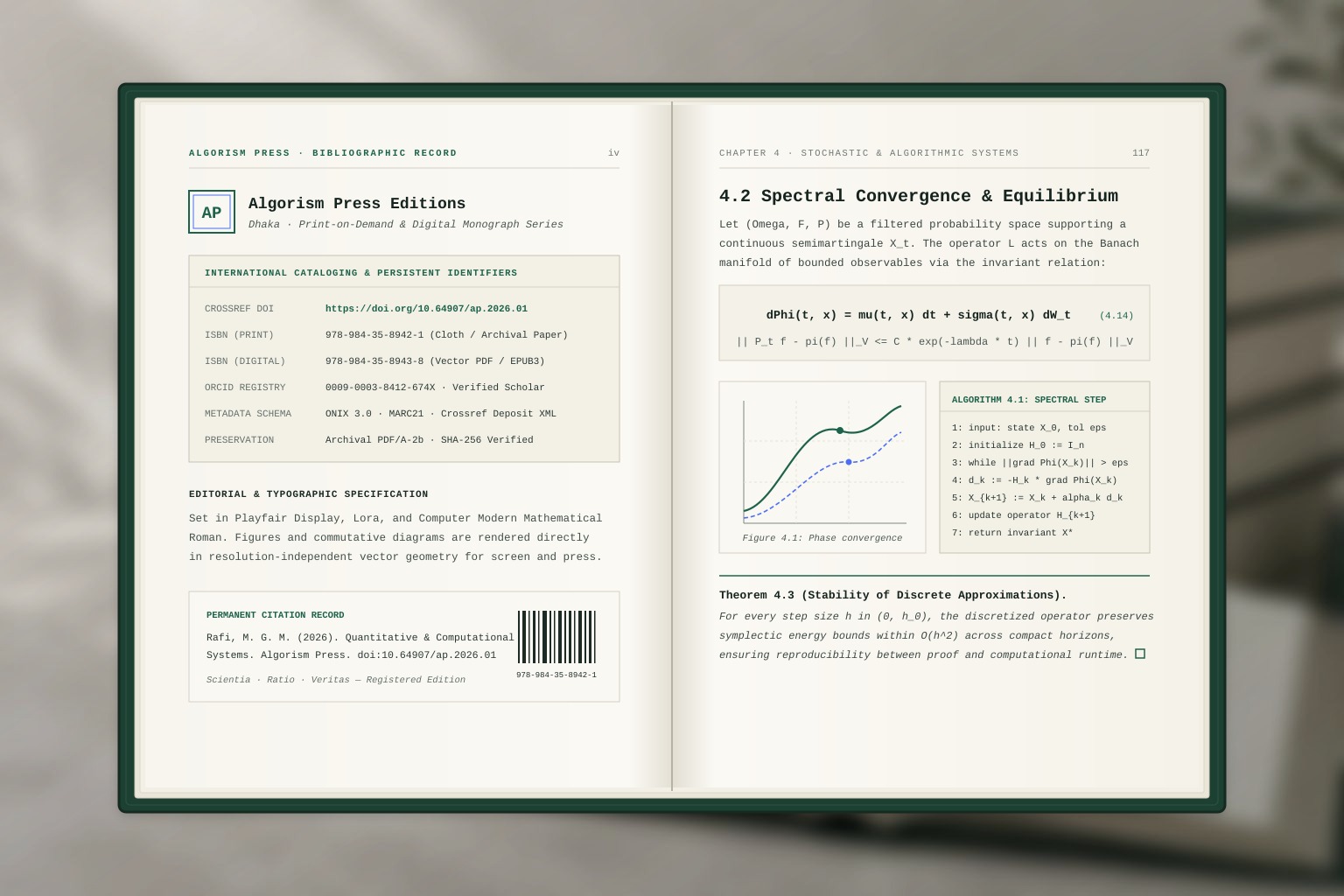
Every published volume and monograph receives registered ISBNs for its print and digital formats, alongside a persistent Crossref DOI, supporting lasting scholarly discovery, library indexing, and accurate citation across research literature.
Complex formulas, algorithmic proofs, and technical figures are set in crisp vector typography, so equations and diagrams stay sharp on high-resolution screens and on paper alike.
Editions are prepared as screen-optimized digital releases and, where offered, as durable print-on-demand volumes, preserving typographic harmony across both formats.
Bibliographic metadata is structured according to international academic cataloging standards, supporting researcher identifiers such as ORCID and institutional library discovery.
Algorism Press concentrates on subjects where structure, evidence, and precision matter most. These disciplines guide our editorial direction.
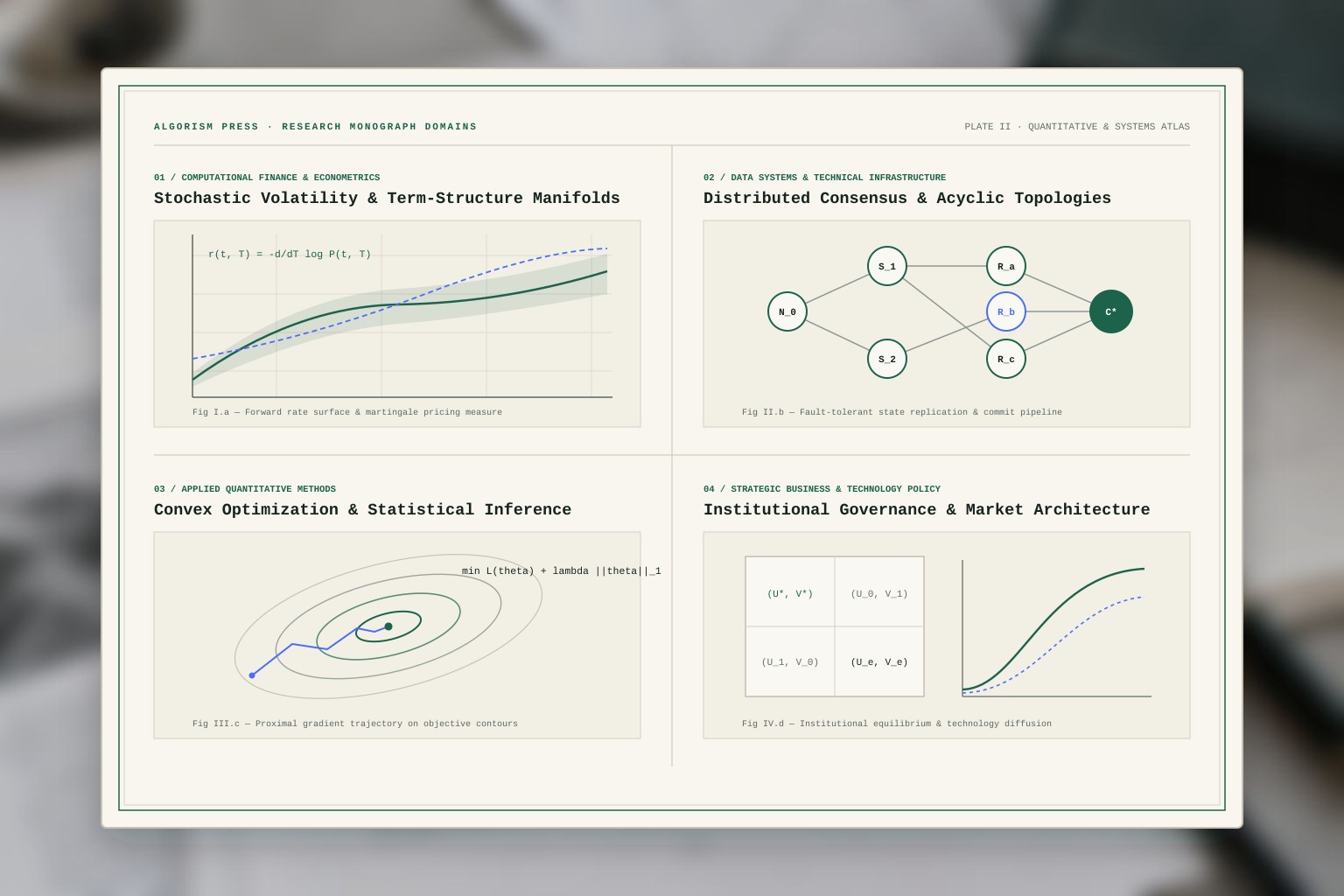
Quantitative methods, continuous & discrete-time financial modelling, market microstructure, and econometric forecasting, presented with mathematical rigor and publication clarity.
Fundamental computer science, distributed algorithms, data-intensive systems, compiler architectures, and high-performance computing infrastructure.
Numerical methods, convex optimization, dynamical systems, control theory, and high-fidelity mathematical modelling across complex engineering and computational domains.
Rigorous statistical inference, probabilistic modelling, Bayesian frameworks, operational research, and empirical data analytics built for real research practice.
Research-led inquiry into how institutions, digital market structures, fintech rails, and emerging technological governance shape global enterprise.
We welcome conversations with educators, researchers, and technical authors about course texts, monographs, and research-led books.
Begin with the subject, intended readership, and current state of your manuscript. Editorial scope, rights, responsibilities, and any commercial terms should be agreed and documented before work begins.
Discuss your manuscriptThe subject and its contribution, the intended readership, a chapter outline, and the current state of the manuscript. A short sample chapter is welcome but not required.
Yes. Lecture notes, lab manuals, and course readers developed for university teaching are a natural fit for our editorial approach.
Rights and responsibilities are agreed in writing before work begins. We do not assume terms; every edition is discussed individually.
Digital distribution allows flexible access models. Access terms are confirmed per edition, in discussion with the author.
“Clear writing, thoughtful design, and careful production. Each in service of the reader.”
Departments and university presses are welcome to discuss course adoption, desk copies, and collaborative editions. We are glad to consider how an edition can serve a specific syllabus or research programme.
Write to us with your course, institution, and the subject you have in mind.
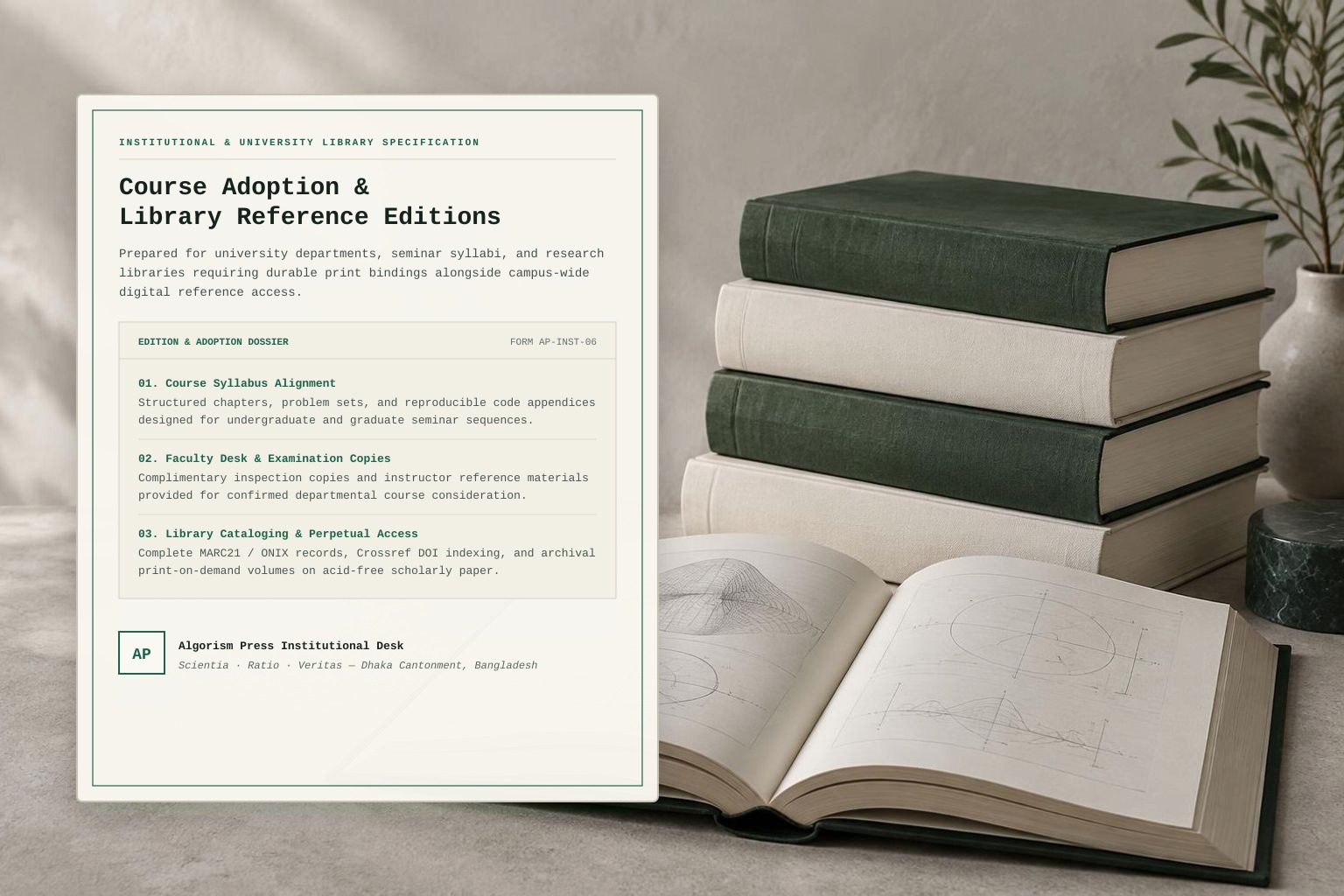
For academic faculty, institutions, and university presses: let’s discuss your manuscript, your readers, and the edition you have in mind.
Institutional Inquiry